
Fayetteville Divorce Lawyers
Fayetteville Divorce Lawyers
Divorce can affect nearly every part of a person’s life, including family structure, finances, and emotional well-being. When legal proceedings begin, people face questions about property division, child custody, alimony, and court requirements. Decisions made during this period may have long-term consequences, so clear legal guidance is important.
A Fayetteville divorce lawyer at Wilmoth Law Firm provides legal support for individuals who are dealing with divorce proceedings in Arkansas. With experience in local court procedures and state divorce statutes, we can prepare you for each stage of the legal process. We focus on key legal issues that impact short-term and long-term outcomes and provide personalized strategies and support.
Why Choose Wilmoth Law Firm as Your Fayetteville Divorce Lawyer?
Wilmoth Law Firm is a woman-owned firm led by attorney Sammi Wilmoth, Esq., who brings years of experience representing clients throughout Northwest Arkansas. Her practice centers on family law, including divorce, custody, and spousal support matters, and she is known for a strong commitment to justice for each client she represents. Clients can expect tailored representation, clear communication, and steady guidance through every stage of the legal process, from filing through final resolution.
What Are the Grounds for Divorce in Arkansas?
Arkansas recognizes both fault and no-fault grounds for divorce:
- Fault-Based Divorce: Arkansas law also allows divorce based on specific grounds such as adultery, cruelty, habitual drunkenness, felony conviction, impotence, or general indignities that make life intolerable. The spouse filing for divorce must provide evidence of the alleged misconduct.
- No-Fault Divorce: You can seek a divorce based on living separately without cohabitation for at least 18 continuous months. No proof of misconduct is required, but the separation period must be uninterrupted.
A Fayetteville divorce attorney can assess which grounds may apply to your case and help you build the necessary documentation.
What Is the Process for Filing for Divorce?
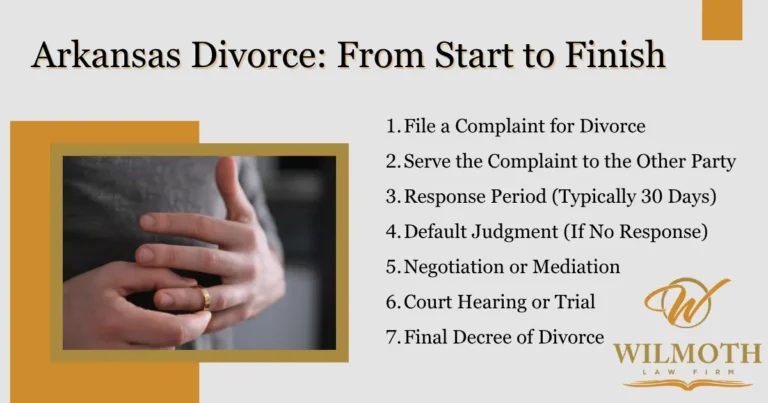
To begin the divorce process in Arkansas, one spouse files a Complaint for Divorce in the circuit court of the county where either spouse resides. The filing must state the grounds for divorce and include information about children, property, and other relevant issues. After filing, the other party must be served with the complaint and allowed to respond. If they do not respond within the required timeframe—typically 30 days—the court may grant a default judgment.
A Fayetteville divorce lawyer assists with every step, from filing the initial paperwork to representing your interests during hearings, negotiations, or trial, if necessary.
How Is Property Divided During Divorce?
Arkansas follows the principle of “equitable distribution.” This means the court seeks to divide marital property fairly, though not necessarily equally.
- Marital property includes most assets and debts acquired during the marriage.
- Separate property typically includes items owned prior to the marriage, personal gifts, or inheritances, unless they were commingled with marital property.
Courts consider factors like the length of the marriage, each spouse’s economic circumstances, and each party’s contributions to the household when determining an equitable division.
Sammi Wilmoth will work to protect your financial interests through detailed asset review and negotiation.
What Are the Rules Concerning Child Custody and Visitation?
In Arkansas, child custody decisions are based on the best interests of the child. Courts generally prefer arrangements that allow children to maintain healthy relationships with both parents, unless doing so would endanger the child:
- Legal custody involves decision-making authority over the child’s education, healthcare, and general welfare.
- Physical custody refers to the child’s primary residence.
Judges consider each parent’s ability to provide a stable home, the child’s emotional needs, and any history of domestic violence. Visitation may be liberal or structured, depending on what is in the child’s best interests.
The Arkansas divorce lawyers at Wilmoth Law helps draft parenting plans that reflect your child’s needs and advocate for fair custody and visitation terms.
Is Spousal Support Available?
Yes. Alimony, also known as spousal support, may be awarded when one spouse is financially dependent and the other has the means to provide support. Courts in Arkansas consider several factors, such as:
- Length of the marriage
- Standard of living during the marriage
- Each party’s income and earning potential
- Age and health of both spouses
Spousal support may be temporary, rehabilitative, or permanent, depending on the circumstances. Our team works to ensure alimony decisions are fair and sustainable.
How Long Does a Divorce Take in Fayetteville?
The duration of a divorce case depends on whether it is contested or uncontested:
- Contested divorces, which involve disputes over property, custody, or support, take longer, often several months or more, due to discovery, negotiations, and court hearings.
- In uncontested divorces, where both parties agree on major issues, the process may take as little as 30 to 60 days after filing.
We aim to move your case forward efficiently while protecting your rights every step of the way.
Can Divorce Agreements Be Modified Later?
Yes. Certain aspects of a divorce order—especially those related to child custody, visitation, child support, and spousal support—can be modified if there is a substantial change in circumstances. Examples include:
- Job loss or increase in income
- Relocation
- Changes in a child’s needs or schedule
To seek a modification, our divorce lawyers in Fayetteville can file a motion with the court and present evidence supporting your request. Property division, however, is generally final and cannot be changed once the divorce is complete.
What Happens if One Party Does Not Follow the Court Order?
If a party violates a court order related to custody, support, or property division, the other party may file a motion for contempt. The court may then impose penalties such as:
- Fines
- Wage garnishment
- License suspension
- Even jail time in extreme cases
We help clients document violations and pursue appropriate enforcement actions to protect their rights.
Can I Get Temporary Orders While My Fayetteville Divorce Is Pending?
Yes. Arkansas courts can issue temporary orders that address child custody, child support, spousal support, and use of the marital home while a divorce case is still moving through the court. These orders remain in effect only until the final decree is entered.
A divorce lawyer can file a motion for temporary relief early in the case so that both spouses have clear guidance on finances and parenting responsibilities during the proceedings.
What Happens to the Marital Home in a Fayetteville Divorce?
The marital home is generally treated as marital property and divided under Arkansas’s equitable distribution rules. Common outcomes include one spouse buying out the other’s share, selling the home and splitting the proceeds, or one spouse retaining the home temporarily until children reach a certain age. Mortgage responsibility, home equity, and each spouse’s ability to refinance also factor into the decision.
Our divorce attorneys help clients weigh these options against their long-term financial goals.
Are Retirement Accounts and Pensions Divided in an Arkansas Divorce?
Retirement accounts and pensions earned during the marriage are typically considered marital property and subject to division. Dividing accounts such as 401(k) plans or pensions often requires a separate court order called a Qualified Domestic Relations Order, or QDRO, to avoid tax penalties and transfer funds correctly.
A divorce lawyer coordinates with financial professionals when needed to make sure retirement assets are divided accurately and in compliance with plan requirements.
How Much Does a Divorce Lawyer Cost in Fayetteville, Arkansas?
Divorce lawyer fees in Fayetteville typically depend on whether the case is contested or uncontested, the lawyer’s hourly rate, and how much negotiation or court time the case requires. Uncontested divorces generally cost less because they involve fewer disputes and less time. Contested divorces, which require discovery, hearings, and negotiation over custody, property, or support, tend to cost more. We offer a free consultation to review the details of a case and provide a clearer cost estimate.
Fayetteville Divorce Lawyers at Wilmoth Law Firm Offer Free Consultations
Whether your case involves property division, child custody, or spousal support, a Fayetteville divorce lawyer at Wilmoth Law Firm will provide guidance rooted in a deep understanding of Arkansas law and local court practices. For a free consultation, call today at 479-443-8080 or contact us online. Located in Fayetteville, Arkansas, we gladly serve clients in the surrounding areas.
Explore Our Blog
Our Practice Areas
Workers’ Compensation